
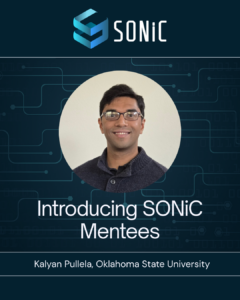
 As part of the SONiC Mentorship Program, contributors work closely with experienced mentors to tackle real-world technical challenges and strengthen the open networking ecosystem.
In this spotlight, we speak with Kalyan Pullela, a first-year PhD student at Oklahoma State University, about his work on integrating SONiC-alpine dataplane testing into SONiC’s Azure Pipelines CI flow. His journey through the program helped shape both his technical expertise and his academic research direction.
About the Mentee
Kalyan Pullela is a first-year PhD student at Oklahoma State University whose research focuses on resilient network systems. During the SONiC Mentorship Program, he worked under the guidance of Brian O’Connor and Arpitha Raghunandan on the “Basic Azure Pipeline with Alpine and KNE” project, where he focused on strengthening SONiC’s dataplane testing and continuous integration workflows.
Q: Can you introduce yourself and share your background?
My name is Kalyan Pullela, and I am a first-year PhD student at Oklahoma State University. I applied to the SONiC Mentorship Program because I wanted to gain a deeper understanding of the software stack on a switch. I had prior experience with P4, and SONiC felt like the natural next step.
As the mentorship progressed, it evolved from simply learning SONiC into a much broader journey. Working with SONiC and its ecosystem helped me discover a concrete research direction in resilient network systems, which I am now pursuing as part of my PhD.
Q: What project did you work on, and why is it important to SONiC?
My mentorship project, “Basic Azure Pipeline with Alpine and KNE,” focused on integrating SONiC-alpine dataplane testing into SONiC’s Azure Pipelines CI flow.
SONiC utilizes Azure Pipelines, but current checks only validate the control plane. This project made dataplane testing a first-class citizen by provisioning a VM in the pipeline, deploying Kubernetes Network Emulation (KNE) and SONiC-alpine, and then running automated dataplane test suites.
This work aims to:
- Improve test coverage beyond the control plane
- Catch dataplane regressions earlier
- Provide a path for contributors to add tests and interpret results
In the longer term, it lays the groundwork for using Alpine-based dataplane tests as pre-submit gates across the SONiC ecosystem, thereby improving overall quality.
Q: What were your main technical contributions?
Core contributions:
- Successfully brought up SONiC-alpine outside of Google’s environment
- Executed SpyTest-based test cases using Alpine and KNE
- Ensured the setup aligned with SONiC community workflows and expectations
This involved using tools such as Alpine, KNE, kubectl, Wireshark, and Docker, as well as modifying Python files on virtual devices to ensure tests ran consistently. I spent significant time debugging issues in containers, topologies, and configurations, often working alongside my mentors and their teammates to resolve problems.
I also presented progress to the SONiC Virtual Data Plane (VDP) working group, which provided valuable feedback from others working on SONiC-alpine and related efforts.
In parallel, I participated in the SONiC hackathon, where I extended Alpine to solve problems that the wider community faces. That work evolved into a separate project, which ultimately led to me receiving the “Rising Star Award” at OCP. I pushed the project to the open-source SONiC-alpine repository, an essential milestone in my open-source journey.
Q: What challenges did you face, and what did you learn?
Like any other project, solving one problem or bottleneck allowed me to progress to the next challenge, as explained below.
Initially, I did not have a server capable of comfortably running SONiC-alpine. After resolving that and bringing up Alpine, I moved on to running SpyTest-based suites, which exposed issues related to containers, architecture, and assumptions built into the broader test framework.
Devices had to be configured in a precise way so that tests could run end-to-end. Multiple containers needed to be healthy, connections to the external traffic generator had to match the topology, and the layout of front-panel ports had to align with what the tests expected.
Getting tests to run all the way through required extensive debugging. Files were missing, ill-formatted files, or were generated in the wrong location. Fixing these issues revealed the next hurdle: many ports were not operational even though they appeared configured.
With guidance from my mentors, I learned how lanes map to front-panel ports and how Lucius (the dataplane) interprets them. Correcting that mapping finally gave us an end-to-end run, though not all tests passed yet.
The hardest remaining problem was enabling packets to traverse from one device to another. Solving this required careful, step-by-step debugging, including validating the configuration, tracing paths, and confirming behavior using Wireshark. That process uncovered the root causes and led to a working solution that allowed connectivity beyond a single device.
From this experience, I learned to approach complex problems methodically, rather than getting discouraged when things go wrong. Technically, I gained a deeper understanding of SONiC’s architecture, its component interactions, and its application in real-world networks. I also became more comfortable with Docker, KNE, and the scripts and configuration files that tie the system together, and I saw firsthand the level of testing and robustness required before a system can be considered production-ready.
Q: What impact has this mentorship had, and what are your next steps?
I plan to continue working in the SONiC-alpine space. Building on the hackathon project, I aim to upstream additional minor changes that make it easier for newcomers to set up Alpine and start testing quickly.
Beyond Alpine, I intend to explore other SONiC variants such as SONiC-VPP and SONiC-DASH. This aligns directly with my research on scale-up and scale-out networks, where SONiC will be a central platform. The mentorship has helped influence my PhD roadmap, and I plan to build and research on top of this work, leading to publications.
Q: Is there anyone you’d like to acknowledge?
I would like to genuinely thank my mentors, Brian O’Connor and Arpitha Raghunandan, for taking the time out of their busy schedules to mentor, guide, and answer my questions. I could not have done this work without their support and help.
I would also like to thank Sonika Jindal and Sreemoolanathan Iyer for their help throughout this journey. Although they were not listed as official mentors, they contributed significantly and were always patient and generous with their time and expertise.
Finally, I would like to thank the SONiC community for creating this opportunity and for being so welcoming. I hope SONiC establishes a pipeline of students with the current batch, helping the next batch while continuing to intern, solving the next set of architectural challenges.
Get Involved
Interested in contributing to SONiC? Join the community and get involved through wiki, mailing lists, and working groups.