
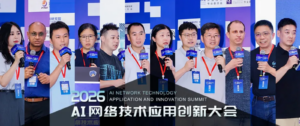
On August 8, 2026, the “2026 AI Network Technology Innovation Conference” took place in Beijing. With strategic support from Alibaba Cloud, the Linux Foundation, and the SONiC community, the conference featured three tracks — a main forum, an AI Infra ecosystem forum, and a SONiC ecosystem forum — drawing over 500 technical experts. The SONiC ecosystem forum, focused on open-source networking and cutting-edge technical practice, stood out as the most technically dense session of the day.
Ethernet-Based Scale Up Test Standard Officially Released
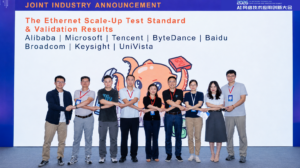
A highlight of the forum was the joint release ceremony of the Ethernet-Based Scale Up test standard. As AI training clusters continue to scale, high-speed interconnects between GPUs and accelerators within a single rack (Scale Up) have become a critical factor in overall system performance. Until now, the industry lacked a unified test baseline for Scale Up networking, making it difficult to evaluate solutions across vendors on a common basis. The release of this standard marks a significant milestone — Scale Up networking is now entering a phase of standardization and interoperability, laying the groundwork for future compliance testing and solution selection.
Eight Technical Talks: From Silicon to Systems, From Protocols to Operations
Following the standard release, the forum moved into its technical session. Eight experts from leading global cloud providers, chip companies, and networking vendors took the stage to share insights on Scale Up interconnects, open-source engineering practices, and AI network operations.
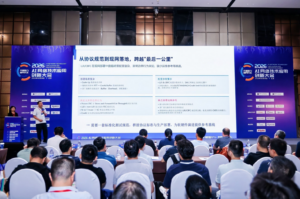 Alibaba Cloud (Haiyang Zheng) and Keysight (Yuanwen Sun) jointly presented LLR/CBFC test strategies and the latest progress. LLR (Link Level Retry) and CBFC (Credit-Based Flow Control) are core mechanisms for ensuring reliable data delivery in Scale Up interconnects. The speakers demonstrated how systematic test methodologies can validate link-layer reliability, providing first-hand engineering data to support the newly released standard.
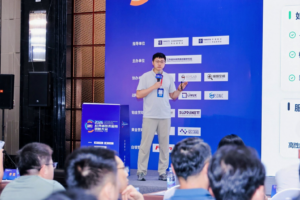 Tencent (Xuefeng Ji) introduced SUNS (Scale Up Network Service), a network service architecture designed for GPU-to-GPU communication within AI clusters. The talk covered architecture design, traffic scheduling, and service-level capabilities, sharing Tencent’s practical experience in productionizing Scale Up networking.
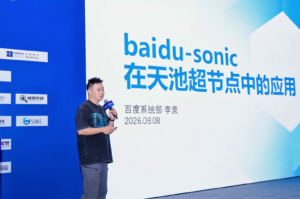 Baidu (Jing Li) showcased the deployment of baidu-sonic in Tianchi super-node products. Tianchi is Baidu’s high-performance computing platform for large-scale model training. The presentation detailed how Baidu deeply customized SONiC and integrated it into Tianchi’s network architecture to support large-scale AI training workloads — demonstrating SONiC’s production readiness in leading internet companies’ AI infrastructure.
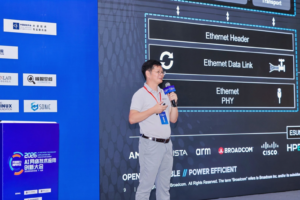
Broadcom (Zongying He) provided a comprehensive overview of Ethernet as the backbone of AI rack server connectivity. As one of the most important chip vendors in the SONiC ecosystem, Broadcom examined Ethernet’s critical role in AI rack-level interconnects from the switching silicon perspective — covering chip architecture, port density, forwarding performance, and the hardware evolution roadmap.
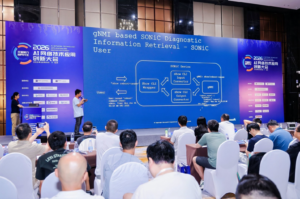
Microsoft (Xin Liu and Michael Ma) shared AI network operations practices. Drawing from Microsoft’s experience operating one of the world’s largest SONiC deployments, the speakers discussed how to achieve efficient network monitoring, fault diagnosis, and automated operations in AI networking scenarios — offering the community an operator’s perspective from hyperscale production environments.
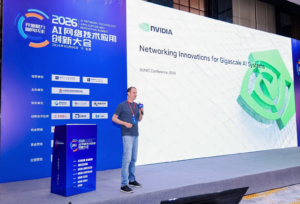
NVIDIA (Barak Gafni) discussed networking innovations for ultra-scale AI systems. As a core participant in AI compute infrastructure, NVIDIA addressed the co-evolution of Scale Up and Scale Out networks from the perspective of GPU cluster requirements, exploring how to achieve tight coupling between networking and compute in ultra-large-scale systems.
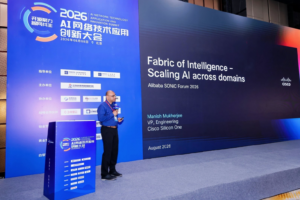
Cisco (Manish Mukherjee) analyzed Scale-Across networking trends from a macro perspective. Scale-Across addresses AI network interconnectivity across racks, regions, and even data centers. Manish explored how to achieve efficient AI cluster connectivity at larger spatial scales from a network architecture evolution standpoint.
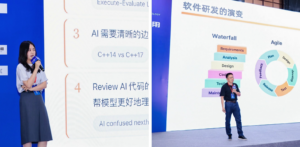 Alibaba Cloud (Eddie Ruan and Yuqing Zhao) shared their experience with Spec-Driven development in the SONiC RIB/FIB project. Spec-Driven development is a methodology where specification documents drive the development process. Using the RIB (Routing Information Base) and FIB (Forwarding Information Base) modules as examples, the speakers demonstrated how rigorous specification and test-driven workflows can improve code quality and community collaboration efficiency in core SONiC modules — offering a reproducible methodology for open-source project engineering.
Panel Discussion: Scale Up Technology Evolving Direction
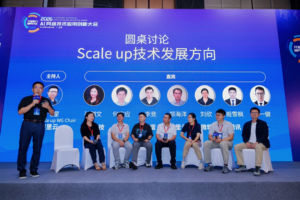 Following the technical talks, the forum hosted a panel discussion on “Scale Up Technology Evolving Direction.” Experts from Alibaba Cloud, Microsoft, Tencent, Baidu, Broadcom, Keysight, and UniVista engaged in an in-depth conversation on Scale Up networking roadmaps, standard evolution paths, and community collaboration models, further building industry consensus.
Closing Thoughts
The SONiC ecosystem forum covered the full technical spectrum — from Scale Up chip-level interconnects to Scale-Across cross-domain networking, from protocol specifications to operational practices, and from test standards to development methodologies. Both the standard release and the engineering talks sent a clear signal: the SONiC open-source community is expanding beyond traditional data center networking into AI compute networks, building the next-generation networking stack for AI infrastructure through open collaboration.