
 Through the SONiC Mentorship Program, contributors collaborate with experienced mentors to solve real-world technical challenges and help advance the open networking ecosystem.
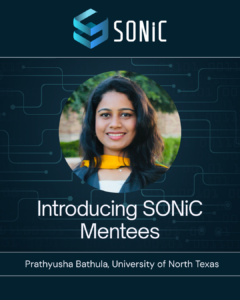
In this spotlight, we speak with Prathyusha Bathula about her work on adding cSONiC support to the SONiC community testbed, helping reduce external dependencies and simplify testbed deployment for contributors.
About the Mentee
My name is Prathyusha Bathula, and I graduated with a Master’s in Information Systems Technology at the University of North Texas. I applied to the SONiC Mentorship Program because I want to learn from experienced professionals to strengthen my technical and professional skills, and also about the chance to contribute to a real community-driven SONiC project. I’m interested in cloud-native networking, network automation, distributed systems, and how open-source NOS platforms like SONiC integrate with cloud infrastructure.
Q: What project did you work on, and why is it important to SONiC?
My project, “Adding cSONiC support in the SONiC community testbed topology,” aims to replace the current vendor NOS (for example, cEOS) used in the community testbed with cSONiC.
The goal is to eliminate external dependencies and simplify the setup and operation of the community testbed for contributors. This project focuses on configuring cSONiC as neighbor devices, enabling features like warm reboot, LACP lag extension, and MACsec, and ultimately upstreaming the full solution to the SONiC project.
Q: What were your main technical contributions?
During the mentorship, I successfully deployed cSONiC as neighbor devices in the SONiC community testbed and established BGP session connectivity between the DUT and the cSONiC neighbors.
My work involved configuring testbed topology, integrating new network setup steps, and validating interfaces and routing behavior. I primarily used Python and Ansible for automation and configuration tasks and collaborated closely with my mentor, Dawei Huang, throughout the development and troubleshooting process. Here is the pull request.
Q: What challenges did you face, and what did you learn?
During the project, I faced several challenges, especially around connectivity issues between the DUT and cSONiC, debugging OVS bridge mappings, and aligning the topology with the community testbed workflow.
These challenges helped me strengthen my troubleshooting abilities, gain a deeper understanding of SONiC’s testbed internals, and improve my Ansible automation and Python development skills. I also gained valuable experience in the open-source contribution process.
Q: What impact has this mentorship had, and what are your next steps?
This work helps the SONiC community by replacing the dependency on vendor NOS (cEOS) with cSONiC for testbed setup, making it easier for people to create and use community testbeds.
I successfully established connectivity between cSONiC and DUT (Device Under Test), which is the foundation for future testing capabilities. This groundwork opens the path for continued development of enabling warm reboot, LACP lag extension, and MACsec.
I plan to continue contributing to complete these features and help the community adopt cSONiC-based testbeds. This experience has strengthened my skills in network automation and open-source collaboration, which I’ll apply in my future career in software-defined networking.
Q: Is there anyone you’d like to acknowledge?
I would like to express my sincere gratitude to my mentors, Dawei Huang and Vaibhav Hemant Dixit, for their guidance and support throughout this internship. Their expertise and patience were invaluable in helping me navigate the complexities of the SONiC testbed infrastructure.
I also want to thank the SONiC community members who provided feedback and assistance during the development process. This project would not have been possible without the collaborative and welcoming environment of the SONiC open-source community.
Get Involved
Interested in contributing to SONiC? Join the community and get involved through wiki, mailing lists, and working groups.